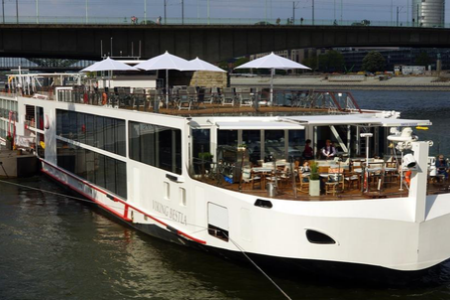

Meals, conversation, and the changing view beyond the windows shape much of the rhythm aboard Viking Bestla. The Restaurant provides the primary setting for breakfast, lunch, and dinner, while the Aquavit Terrace offers a more casual alternative where guests can dine with an open connection to the river. Regional dishes often complement familiar selections, giving travelers another introduction to the places being explored ashore. Nearby, the Lounge transitions easily from a quiet daytime gathering space into a setting for destination talks, cultural programming, and relaxed evenings after a day of touring.
Built in 2014, Bestla belongs to the innovative Longship fleet operated by Viking. Her 443-foot profile accommodates 190 guests in 95 staterooms while maintaining the intimate scale that defines European river travel. Scandinavian influences appear throughout the interior through natural materials, restrained colors, contemporary furnishings, and an abundance of glass. Instead of separating passengers from their surroundings, the ship is arranged to keep the river visible throughout much of the day, reinforcing the connection between life onboard and the destinations unfolding outside.
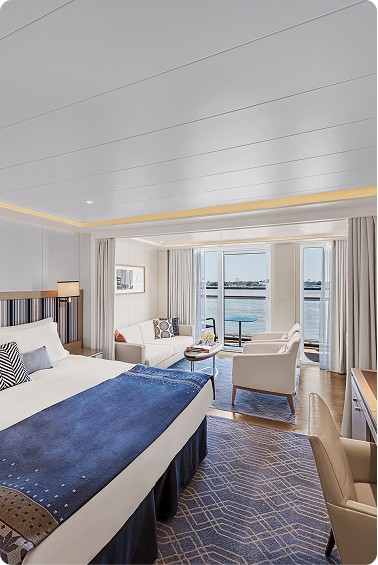
That philosophy extends to the accommodations. Bestla offers Standard Staterooms, French Balcony Staterooms, Veranda Staterooms, Veranda Suites, and spacious Explorer Suites, allowing travelers to choose between an efficient cabin and accommodations with considerably more room. The asymmetrical Longship layout makes particularly effective use of the ship’s limited width, creating space for true verandas and larger suites without sacrificing important public areas. Explorer Suites occupy some of the most desirable positions aboard and add separate living areas along with expansive river views, while French Balcony cabins provide a more compact way to enjoy fresh air and scenery.
When conditions allow, the Sun Deck becomes one of Bestla’s most rewarding places to spend time. From here, there is little separating guests from the landscapes of Europe as the vessel moves between major cities and smaller riverside communities. Seating areas provide places to read or simply watch the scenery, while the elevated perspective is particularly valuable during stretches lined with vineyards, castles, church towers, historic villages, and working locks. The experience changes continuously, making time spent underway an important part of the journey rather than merely transportation between ports.
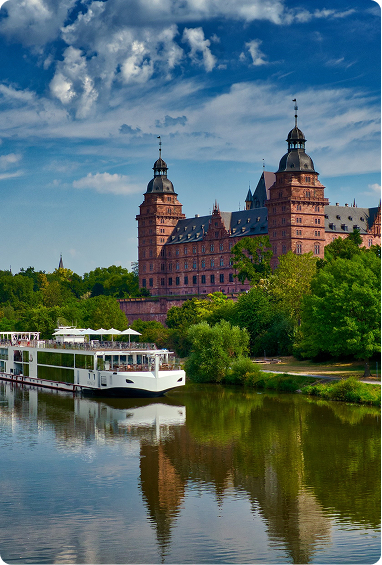
Bestla’s itineraries take advantage of the interconnected waterways of Central Europe, including voyages along the Rhine, Main, and Danube. Depending on the sailing, guests may travel through the Netherlands, Germany, Austria, Slovakia, Hungary, France, or Switzerland, with cities such as Amsterdam, Vienna, Budapest, Cologne, and Basel serving as important gateways. This style of European river cruising makes it possible to experience several distinct regions while unpacking only once, with guided exploration ashore balanced by scenic cruising between destinations.
The experience is especially appealing to travelers who prefer cultural discovery over a busy resort atmosphere. There are no sprawling entertainment complexes or endless lists of onboard attractions competing for attention. Instead, Bestla provides comfortable accommodations, thoughtful gathering spaces, destination-oriented enrichment, and a setting designed to complement each day ashore. The result is a river ship that functions naturally as part of the journey—providing a refined place to dine, relax, learn, and watch Europe gradually change from one destination to the next.

 Viking Bestla


 Mange your Bookings