I have always felt that food is one of the best ways to remember a trip. You might forget the name of a building you walked past or exactly which museum you visited on Tuesday, but somehow you remember that little restaurant where the bread was still warm, the olive oil tasted completely different from what you buy at home, and you ordered something without really knowing what was going to arrive.
That is what makes Silversea's S.A.L.T. program so interesting.
S.A.L.T. stands for Sea And Land Taste, but calling it a culinary program does not really explain what makes it different. Plenty of luxury ships have excellent restaurants and impressive chefs. Here, the idea is to connect what you are eating onboard with where you are actually traveling.
One of the best examples is a journey through Greece and Cyprus aboard Silver Moon, the ship where the full concept originally debuted. Imagine starting in Athens and visiting Syros, Paros, Patmos, Rhodes, Crete, Mykonos and Limassol in Cyprus. These places may not look particularly far apart on a map, but their food traditions can change considerably from one island to another.
That is when S.A.L.T. starts making sense. You are not simply eating "Greek food" because the ship happens to be in Greece. You begin tasting the differences between the places you are visiting.
S.A.L.T. Kitchen Was the Part That Caught My Attention
At first, I assumed S.A.L.T. Kitchen would work like a normal specialty restaurant. You look at the menu on the first night, find a few things you like, and perhaps come back later in the cruise to order something different.
That is not really how it works.
There is a menu inspired by the broader region, while other dishes become much more specific to where the ship is traveling. A dinner after spending the day in Syros can therefore feel different from what appears after Rhodes or another island.
I really like this approach because it gives you an opportunity to try something without committing your entire afternoon ashore to finding it. Around the Greek Isles, you may encounter familiar ingredients such as good olive oil, seafood, local cheeses, honey, herbs and vegetables, but then something appears that you probably would never have thought to order yourself.
One example from Syros is aeopita, a fisherman's flatbread topped with swordfish. Other menus have featured pork slowly braised with quince, while Rhodes has even inspired dishes using local snails.
Those are the things that interest me.
I can order grilled salmon or a steak almost anywhere in the world. If I am sitting on a ship off a Greek island, I want somebody to put something in front of me that makes me ask what it is.
If I love it, great. If I take two bites and decide it is not for me, that is part of traveling too.
Crete Is Where the Idea Really Comes Together
If I had to choose one place where S.A.L.T. really shows what it is supposed to be, I would choose Crete.
Cretan cooking depends heavily on relatively simple ingredients being very good. Olive oil, vegetables, herbs, grains, cheese, bread and meat do not necessarily sound extraordinary when written on a menu. Then you eat them
somewhere they have been grown or produced locally and suddenly you understand why people make such a fuss about them.
One of the culinary experiences here takes guests into the countryside to Peskesi Farm, where the experience is much closer to sitting down for a traditional Cretan feast than visiting a polished tourist restaurant.
There is lamb prepared antikristo style beside the fire rather than directly over the flames. Pork is slowly cooked with bulgur and vegetables. Fresh bread comes to the table alongside stuffed zucchini flowers, dolmades and produce grown nearby.
That smell of meat cooking beside a wood fire is something a menu description simply cannot recreate.
And the food is not supposed to look overly perfect. That is actually part of what I like about it. A meal like this should look like somebody cooked it for you rather than spent twenty minutes arranging it with tweezers.
You sit down, dishes are passed around, somebody tears off another piece of bread, you try a little more of something you did not expect to like, and suddenly lunch has lasted much longer than you planned.
Those are usually the meals I remember.
Paros Made Me Look at Something as Simple as a Chickpea Differently
Some of the most interesting foods involved are not expensive ingredients at all.
Take revithada.
It is a traditional Cycladic chickpea dish that is slowly cooked for hours. At home, chickpeas might be something I throw into a salad without giving them much thought. On the islands, there is history attached to the way they are prepared.
Paros has also hosted experiences involving bread and phyllo pies prepared by the sea. None of this necessarily sounds like what people imagine when they hear "luxury cuisine," but I think that is exactly the point.
The luxury is having access to the people and places that help you understand why these foods still matter.
I would much rather learn why a family has made bread or phyllo a certain way for generations than spend an entire afternoon being served tiny portions simply because a restaurant is expensive.
This is one of the things I enjoy most about traveling through the Mediterranean. Food can change noticeably over relatively short distances, and some of the best things you eat are often the simplest.
Mykonos Is About More Than Beach Clubs and White Buildings
Most people have a pretty clear image of Mykonos before they ever arrive.
Whitewashed buildings, blue doors, narrow streets, windmills, beautiful water and expensive beach clubs.
Cheesemaking probably does not make the first page of the list.
That is exactly the kind of thing I enjoy discovering when I travel. S.A.L.T. experiences on Mykonos have introduced guests to local, multigenerational sheep-herding cheesemakers and the traditions behind the island's cheeses.
Suddenly something that would normally be a small item on a plate becomes more interesting. You start thinking about the milk, the animals, the family producing it and why cheese made on this particular island tastes the way it does.
Then you return aboard and encounter those flavors again.
Now they have context.
That connection between what happens ashore and what later appears on the table is probably my favorite part of the entire concept.
S.A.L.T. Lab Is Not a Cooking Demonstration
I have seen plenty of cooking demonstrations where everyone sits in rows while a chef prepares something on a stage.
S.A.L.T. Lab is much more hands-on.
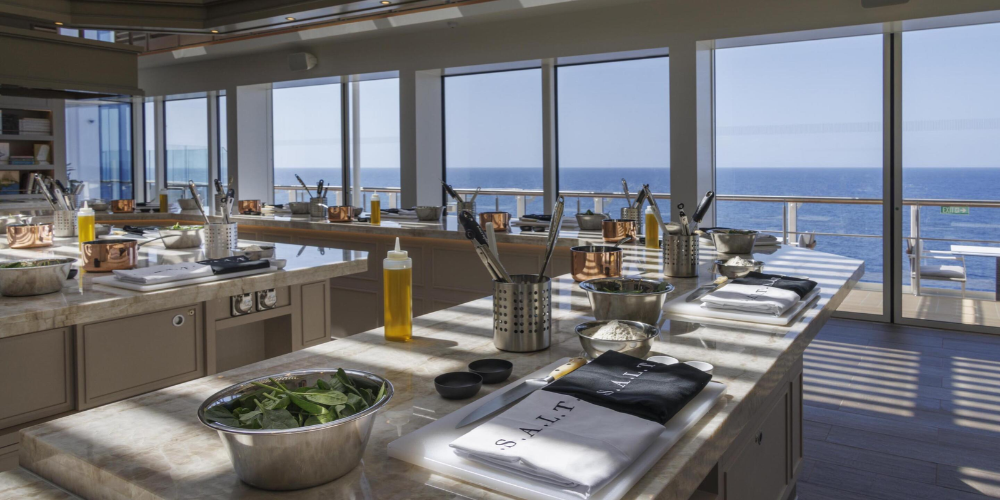
The space feels like a real teaching kitchen, with individual workstations and ingredients prepared for the class. The chef or host guides everyone through the recipe, but you are actually chopping, mixing, tasting and attempting to make the dish yourself.
You do not need to know what you are doing. In fact, I think it is probably more fun if you don't.
On a Greek itinerary, a class might introduce ingredients such as figs, local cheeses, herbs and honey or explore a dish connected to somewhere you have recently visited. The recipes change as the ship moves to other parts of the world.
The part I appreciate most is the context. You are not simply told to add an ingredient. You learn why people in the region cook with it, where a dish came from and why it became part of the local food culture.
That turns a cooking class into something closer to a history lesson you get to eat afterward.
And yes, yours may not look quite like the chef's.
I would consider that part of the experience.
Do Not Overlook S.A.L.T. Bar
I originally thought the bar would be the least interesting part of the program. Then I started looking at what they actually do.
The drinks travel too.
Instead of walking in and seeing nothing but the same cocktails you could order at practically any hotel bar, local spirits and regional ingredients influence what is being poured.
In Greece, that might mean discovering a Greek gin or another spirit you probably would never order at home. The bartenders can get creative with presentation too, but the part that interests me more is being introduced to something connected to the destination.
I would probably stop here before dinner, particularly on an evening when I was eating at S.A.L.T. Kitchen. Have a drink influenced by the region, move into dinner based on where you spent the day, and suddenly the evening feels like a continuation of the trip rather than the moment you left Greece behind and walked back onto the ship.
It is a small detail, but it changes the experience.
Cyprus Changes the Flavors Again
Then the ship reaches Cyprus and things move in another direction.
One culinary experience has involved local wine and making soutzioukios, a traditional sweet made using grape must. This is exactly the kind of thing I probably would not have known to search for before visiting.
I already know about the famous attractions. If I am going to Athens, I know I want to see the Acropolis.
What I find more interesting are the things I did not know enough to look for.
What does a family make here that I have never heard of? What wine do people drink? What would somebody's grandmother insist I taste before leaving?
That is where culinary travel becomes interesting.
It is also why I would not describe S.A.L.T. as simply Mediterranean dining. Move the ship somewhere else and the experience follows it. Spain, Portugal and Italy bring different ingredients, wines, cooking techniques and traditions. Take the program outside Europe and it changes again.
The ship may be familiar. The food should not be.
Which Silversea Ships Have S.A.L.T.?
This is worth checking before booking because the experience is not identical across the entire fleet.
Silver Moon is where the full S.A.L.T. concept originally debuted and remains the ship I associate most closely with its beginnings. The program has since expanded to additional vessels, including Silver Dawn, Silver Nova, Silver Ray and Silver Spirit.
The newer Silver Nova and Silver Ray take the physical experience further. Their S.A.L.T. Lab spaces are larger and brighter, with big windows that make the cooking environment feel more connected to the world outside.
On these newer ships, the space can also become S.A.L.T. Chef's Table in the evening. Instead of preparing the food yourself, you sit down for a much more intimate multicourse experience where the culinary team can tell the destination's story through a progression of small dishes.
If the culinary side of the trip is one of your main reasons for booking, I would pay attention to the specific ship rather than simply searching for any Silversea sailing that mentions S.A.L.T.
I Would Not Spend the Entire Cruise Chasing S.A.L.T.
This may sound strange after spending this much time talking about the program, but I think it is important.
Do not turn the entire vacation into a week-long cooking course.
There are already very good restaurants elsewhere onboard, and sometimes after a full day ashore you may simply want a familiar meal, a glass of wine and an early night.
That is okay.
I think S.A.L.T. works best when you pick the parts that genuinely interest you. Take a Lab class. Try the Kitchen more than once because the menu evolves. Stop at the Bar before dinner. If there is a culinary excursion that sounds particularly good, book it.
Then go explore normally too.
The same advice applies to the shore experiences. If you love wine, visiting a vineyard makes sense. If you genuinely enjoy cooking, learning to prepare bread or meeting local cheesemakers could become one of the highlights of the trip.
If you hate cooking, do something else.
You do not need to experience every component to understand the idea.
The Greek Isles Are Where I Would Start
If someone asked me where I would first experience S.A.L.T., I would have a hard time choosing anywhere other than the Greek Isles.
Part of that is because this is where the concept began, but the bigger reason is how easily you can see the differences between places that initially look very similar on a map.
One day it may be bread and chickpeas. Another brings local cheese. In Crete, it becomes lamb beside a wood fire, vegetables, herbs and olive oil. Reach Cyprus and suddenly local wine and grape must enter the picture.
The ingredients are not always complicated.
That is what makes them memorable.
A ripe tomato with good olive oil and local cheese can taste better than something containing twenty ingredients when the tomato was picked when it was supposed to be picked and the cheese came from somebody who knows exactly what they are doing.
Mediterranean cooking reminds you of that very quickly.
The Question I Ask About Cruise Food Has Changed
Most of the time when we talk about cruise dining, we ask the same questions.
How many restaurants are there? Is the food good? Which restaurants cost extra?
Those things still matter, but I think there is another question worth asking:
Does the food tell me anything about where I am?
That is what makes this concept different.
You can spend the day learning about cheese on Mykonos and recognize those flavors differently when they appear again. You can discover why a particular ingredient matters during a cooking class and notice it somewhere else later in the journey. You can order a regional spirit that you probably would have walked right past at home.
Food becomes part of the itinerary.
And that is exactly what I want from a trip like this.
If I am flying across the Atlantic and spending thousands of dollars on a Mediterranean vacation, I do not want every meal to taste like something I could have ordered at home.
I want to taste something I cannot pronounce. I want somebody to explain how their family makes it. I want to discover something I never would have ordered on my own—and every once in a while, I want to try something, smile politely and decide once was enough.
Those are the meals you remember.
S.A.L.T. does not simply bring good food onto a luxury ship.
It brings a little bit of the destination back with you.


 Mange your Bookings